
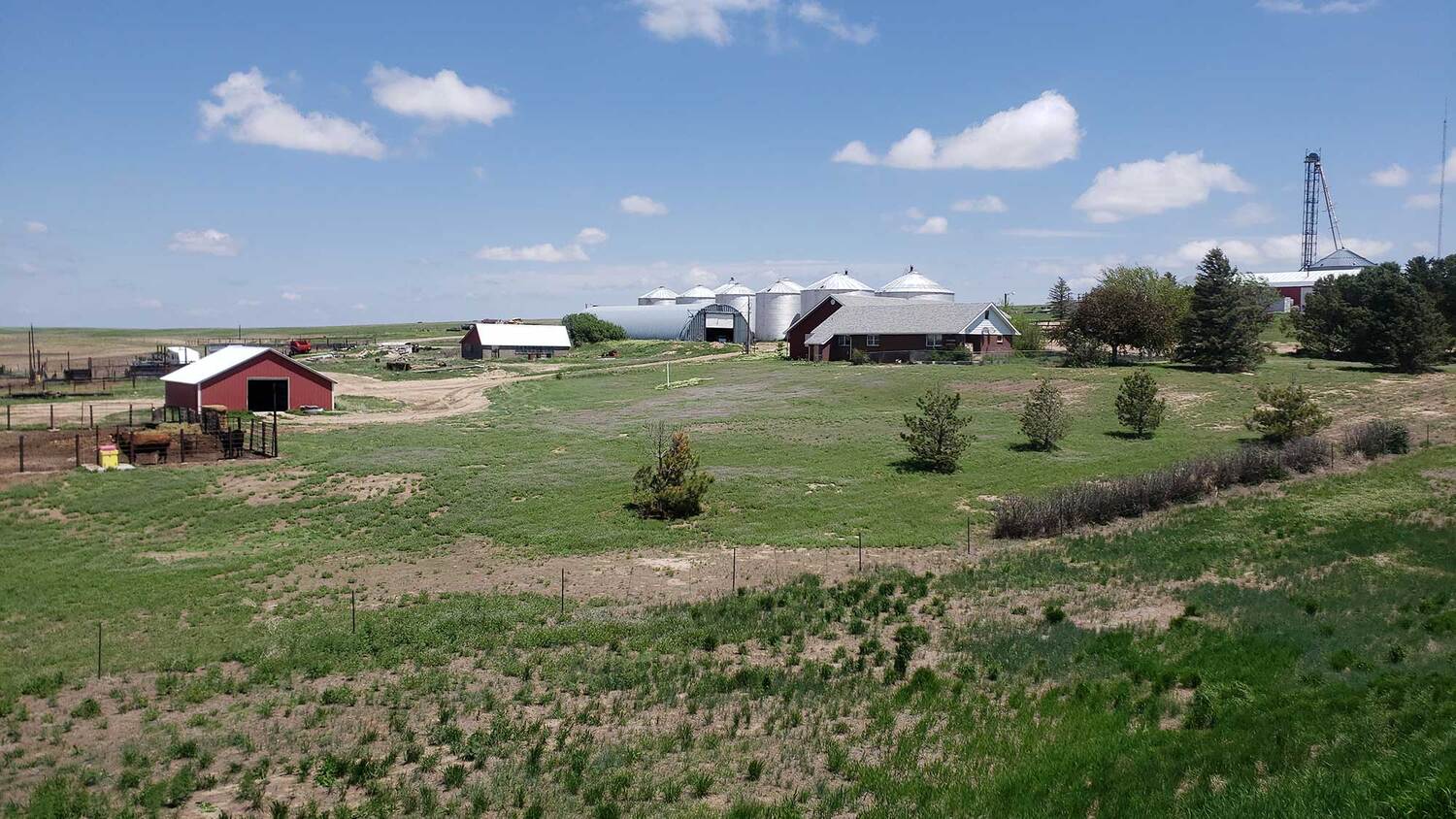
Wright Farm & Ranch
Akron, Colorado | Washington County | 10651 Acres
Property Information
Wright Farm & Ranch is a diversified dryland farm and commercial cattle operation encompassing approximately 10,651± acres in southern Washington County, Colorado. Comprised of 4,257± acres of productive dryland cropland, 5,787± acres of native grass pasture, and 640± acres of State of Colorado Land Board leased grazing land, the ranch has been assembled into a predominantly contiguous operation where farming and livestock production complement one another. Opportunities to acquire a farm and ranch of this scale, quality, and operational continuity have become increasingly uncommon across Colorado’s Eastern Plains.
Wright Farm & Ranch offers the kind of versatility that's becoming harder to find—a productive agricultural operation paired with the space, privacy, and long-term value that land buyers seek. Properties like this appeal to working producers, investors, and families looking to build a lasting legacy on quality ground.Close Details
LOCATION
Located along U.S. Highway 36 between Anton and Lindon, the ranch is approximately 90 minutes east of Denver and Denver International Airport, one hour south of Brush and Interstate 76, one hour north of Limon and Interstate 70, and just 30 minutes from Akron, the county seat and home of the Colorado Plains Regional Airport. Local services, including groceries, fuel, and the Anton Cooperative, are only minutes from the headquarters, providing convenience without sacrificing the rural character of this productive agricultural region.
ACREAGE
The strength of Wright Farm & Ranch lies in the balance between productive cropland and healthy native rangeland. The predominantly contiguous acreage allows efficient movement of equipment and livestock while simplifying day-to-day management across the operation. Of the total acreage, 4,257± acres are in dryland cultivation, 5,787± acres are native pasture, and 640± acres are leased from the Colorado State Land Board. The Sellers will assist in transferring the State lease, subject to approval by the Colorado State Land Board.
The gently rolling landscape reflects generations of agricultural stewardship, providing a land base equally suited for grain production and commercial cattle grazing.
CROPLAND
The dryland farm is anchored by deep, productive Weld silt loam, Keith-Kuma silt loam, and Norka loam soils that have long been recognized among the most productive dryland soils on Colorado’s High Plains. Approximately 75 percent of the cropland consists of Weld silt loams with exceptional moisture-holding capacity, while the Keith-Kuma associations are valued for their organic content and consistent production.
Current no-till and minimum-till farming practices conserve moisture and improve long-term soil health while producing winter wheat, corn, and millet for both commercial grain sales and livestock feed. Research from the nearby CSU Plains Research Center in Akron demonstrates the capability of these soils, with average winter wheat yields of 38 to 48 bushels per acre and average dryland corn production of 55 to 75 bushels per acre. In favorable moisture years, wheat commonly exceeds 55 bushels, while corn can surpass 100 bushels per acre, reflecting the productivity of these well-managed soil profiles.
GRASSLAND
Complementing the cropland are 5,787± acres of productive native shortgrass prairie dominated by Blue Grama, Buffalo Grass, Western Wheatgrass, Side-oats Grama, Prairie June-grass, and Sand Dropseed. These native grasses have sustained livestock production across eastern Colorado for generations and continue to provide the foundation for the ranch’s commercial cow-calf operation.
The grazing system is supported by an extensive network of pipelines, strategically located stock tanks, natural springs, and runoff ponds, while well-maintained perimeter and cross fencing allow cattle to move efficiently throughout the ranch without hauling. Native range on these productive soils typically supports 0.25 to 0.45 AUMs per acre, or approximately 11 to 20 acres per cow-calf pair during a five-month grazing season, providing both operational efficiency and long-term rangeland sustainability.
IMPROVEMENTS
The headquarters reflects the functionality expected of a diversified agricultural operation of this size. Three residences serve the ranch, including a well-appointed 5,000-square-foot brick home with a full basement that anchors the headquarters.
Working improvements are equally impressive and designed to support efficient year-round operations. The grain handling facility includes approximately 355,000 bushels of storage and a 70-foot truck scale with scale house, providing valuable marketing flexibility during harvest. Equipment storage and maintenance are accommodated by a 60’ x 175’ insulated shop, a 40’ x 100’ Quonset, and an additional 40’ x 140’ shop located at the backgrounding lot. Livestock facilities include working corrals with processing chute and load-out, a backgrounding feedlot, and a dedicated calving barn, creating infrastructure capable of supporting both the farming and cattle enterprises with efficiency and practicality.
AGRICULTURAL OPERATIONS
Wright Farm & Ranch has been developed as an integrated dryland farming and commercial cow-calf operation where each enterprise strengthens the other. Grain production provides both a dependable cash crop and a valuable feed source for the livestock operation, while conservation farming practices preserve the productivity of the soils for future generations.
The Sellers operate a commercial cow herd comprised primarily of Angus-based genetics complemented by Red Angus bulls. Calves are generally weaned and preconditioned before marketing, with quality replacement heifers retained to strengthen the herd. Most steers and remaining heifers are marketed through regional feedlots, while a select number of cattle are finished locally for direct beef sales.
Because the ranch is largely contiguous, cattle can be rotated through the grazing system without trucking, reducing labor while allowing the native grass resource to be managed efficiently. Nearby grain elevators, feedyards, and livestock auction facilities further enhance the marketing opportunities available to the operation.
WATER, MINERAL & NATURAL RESOURCES
Water has long been one of the cornerstones of successful ranching on the eastern plains, and Wright Farm & Ranch has been developed with that understanding in mind. Livestock water is distributed through an extensive pipeline network supplying strategically located tanks across the ranch, supplemented by natural springs and runoff ponds that provide additional seasonal water sources.
All appurtenant water rights associated with the property will transfer to the Buyer at closing. No mineral rights are included in the sale.
WILDLIFE & RECREATION
Although first and foremost a productive agricultural operation, the ranch also offers recreational attributes associated with large, privately owned holdings on Colorado’s eastern plains. Native grasslands, draws, and agricultural fields provide quality habitat for plains mule deer, pronghorn antelope, upland game birds, small game, and varmints.
The diversity of habitat, coupled with the scale of the property, provides enjoyable hunting and outdoor recreation while complementing—not competing with—the ranch’s primary agricultural purpose.
REGION & CLIMATE
Southern Washington County has earned its reputation as one of eastern Colorado’s productive dryland farming regions through a combination of fertile soils, native prairie, and a climate well suited to diversified agriculture. Average annual precipitation is approximately 16.54 inches, with nearly 75 percent falling during the April through September growing season.
May and June provide the critical moisture that supports winter wheat development, while July thunderstorms often replenish soil profiles for corn and summer forage crops. Average annual snowfall of approximately 40 inches contributes additional moisture, particularly where standing residue and no-till farming practices capture drifting snow. The region’s typical 140- to 145-day growing season has proven well suited for drought-tolerant crop varieties and conservation farming systems that have become hallmarks of successful High Plains agriculture.
SUMMARY
Wright Farm & Ranch represents the kind of agricultural holding that becomes increasingly difficult to assemble in today’s marketplace. The productive dryland soils, healthy native rangeland, extensive livestock water systems, substantial grain storage, quality improvements, and a well-established commercial cattle operation, the property offers both immediate functionality and long-term agricultural value.
The farm and ranch may also be purchased separately as the Wright Farm or Wright Ranch offerings. Please refer to those individual listings for additional information.
 Download Brochure