
Independent cattle organizations give working producers a direct voice in the policies, markets and regulations that influence whether family ranches remain economically viable. Their annual meetings are more than industry gatherings. They are working forums where producers identify challenges, debate solutions and help shape positions that may affect ranching operations for generations.
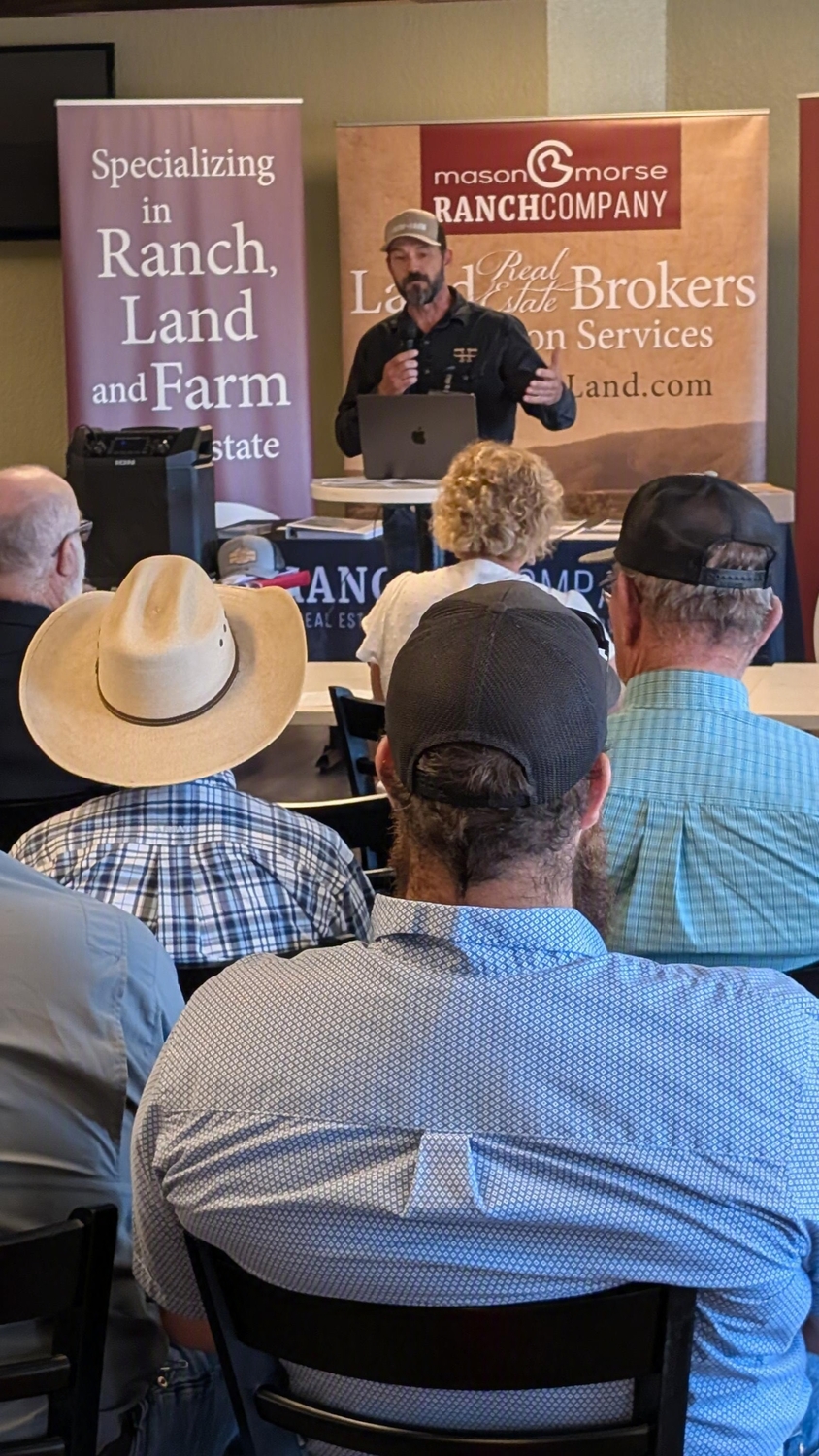
That producer-led purpose was evident during the 21st Annual Convention of the Colorado Independent Cattle Growers Association, held July 17–18, 2026, in Cortez, Colorado.
Mason & Morse Ranch Company participated as a Platinum Sponsor and was represented at the convention by Partner and Associate Broker Scot Oliver, ALC, and Associate Broker John Fowle, ALC. Their attendance reflected the company’s continued support for Colorado agriculture, independent cattle producers and the rural communities that depend on productive working lands.
The Importance of “Independent” in Colorado’s Cattle Industry
The word independent is central to the Colorado Independent Cattle Growers Association, commonly known as CICA.
The organization was formed by Colorado cattlemen and cattlewomen who wanted producers to have a stronger voice in the decisions affecting their operations. Its mission is to promote policies that benefit the live cattle industry at the local, state and national levels while helping secure and preserve viable agricultural operations for present and future generations.
That grassroots structure matters because policies affecting ranchers are often most effective when they are informed by people who understand the operational consequences on the ground.
A regulation that appears reasonable from a distance may have very different effects when applied to a working cattle ranch with limited labor, seasonal forage, variable precipitation, complex water rights or federal and state grazing agreements.
Independent producers understand what it takes to:
- Maintain fences, corrals and livestock-handling facilities.
- Develop and protect dependable livestock water.
- Manage drought, wildfire risk and changing forage conditions.
- Purchase feed and respond to volatile input costs.
- Comply with evolving state and federal requirements.
- Move cattle between seasonal pastures and grazing allotments.
- Maintain a viable agricultural operation through unpredictable market cycles.
Producer organizations create a place where that practical experience can be translated into education, policy positions and collective action.
How Grassroots Agricultural Policy Is Developed
CICA’s policy process illustrates the difference between a producer-led organization and a top-down advocacy structure.
The association’s policies are reviewed by its members, including during the annual convention. Producers may raise concerns, propose resolutions and participate in discussions involving current agricultural and cattle-industry conditions.
This process serves several important purposes:
- It keeps policy positions connected to real operating conditions.
- It allows producers from different regions to compare experiences.
- It gives individual members an opportunity to raise local concerns.
- It creates positions that can be communicated to elected officials and regulatory agencies.
- It encourages producers to participate directly in the future of their industry.
The annual convention is therefore more than a social event. It is part of the organization’s governance process and an opportunity for producers to help determine which issues deserve attention.
The 2026 convention in Cortez included committee meetings, resolution discussions, a formal business meeting and presentations addressing issues affecting independent cattle producers. It also provided an opportunity for ranchers, agricultural businesses and industry professionals to exchange ideas and strengthen working relationships.
Why Cattle Policy Matters to Ranch Ownership
Public policy and cattle-market conditions do not exist separately from the land. They can directly influence how a ranch operates, what it costs to maintain and how buyers and sellers evaluate its long-term value.
Several areas are particularly important to ranch owners, prospective buyers and agricultural land professionals.
Operating Costs and Regulatory Requirements
Compliance requirements may add labor, infrastructure, reporting, recordkeeping and professional-service expenses to a cattle operation. Even when individual costs appear manageable, their cumulative effect can influence profitability in a business already exposed to weather, livestock prices, feed costs, fuel prices and interest rates.
Understanding those costs is essential when evaluating a ranch’s sustainable operating income and its ability to support a family, workforce or future generation.
Market Competition and Price Transparency
Independent producers often sell into a market in which they have less negotiating power than larger participants farther along the supply chain.
Producer organizations frequently focus on competition, price discovery, labeling, trade and market structure because those issues may affect the revenue ranchers receive for their livestock.
Changes in cattle revenue can influence decisions involving:
- Herd size and replacement rates.
- Land expansion or liquidation.
- Retained ownership strategies.
- Grazing leases and pasture use.
- Capital improvements.
- Succession and estate planning.
Water, Grazing and Land-Use Policy
Water availability, federal and state grazing privileges, wildlife management, environmental requirements and local land-use rules can all affect the practical utility of a ranch.
A property may contain substantial acreage but have limited operational capacity if water distribution, forage access or grazing authorizations are uncertain. Conversely, well-managed land with dependable water, documented carrying capacity and functional grazing infrastructure may offer value that is not immediately visible from acreage alone.
For buyers and sellers, the legal and operational details connected to water, grazing and land use should be investigated carefully during the valuation and due-diligence process.
Private Property and Operational Flexibility
Ranch value is influenced by what an owner can legally and practically do with the land.
Easements, public access, conservation restrictions, mineral ownership, water rights, zoning and government grazing agreements may support or limit future use. These factors can affect agricultural production, financing, resale potential and long-term ownership goals.
Producer organizations help bring working-land perspectives into policy discussions that might otherwise treat agricultural land only as open space without fully accounting for the business required to maintain it.
Generational Continuity
A ranch cannot pass successfully to another generation through sentiment alone. It must remain operationally and financially sustainable.
Policies affecting cattle prices, input costs, taxation, grazing access, land-use flexibility and estate planning can influence whether the next generation is able to continue an agricultural operation.
CICA’s emphasis on preserving viable cattle operations for present and future generations recognizes that ranch succession depends on both stewardship and economics.
The Relationship Between CICA and R-CALF USA
CICA is closely aligned with R-CALF USA, a national nonprofit organization representing independent U.S. cattle and sheep producers in trade and marketing matters.
This relationship gives Colorado producers a way to bring state and local concerns into a broader national discussion.
CICA can concentrate on conditions affecting Colorado ranchers, while R-CALF USA addresses national and international matters involving cattle markets, competition, trade and industry structure.
The relationship also allows information to move in both directions. National developments can be communicated to local producers, while concerns originating on Colorado ranches can be elevated to a national organization.
R-CALF USA’s mission centers on supporting the continued profitability and viability of independent cattle and sheep producers. Its work has included issues involving market competition, country-of-origin labeling, livestock identification, international trade and the federal beef checkoff program.
Producers do not have to agree on every issue to recognize the value of participation. A healthy agricultural industry depends on informed discussion, competing viewpoints and the involvement of people who bear the financial and operational consequences of the policies being debated.
Why Annual Cattle Conventions Remain Valuable
Modern communication allows producers to receive industry news almost instantly, but it does not replace in-person discussion.
Annual conventions allow cattle producers to speak directly with other operators, compare regional conditions and determine whether a problem is isolated or widespread. They also provide opportunities to meet association leaders, hear policy presentations and participate in the resolution process.
For younger producers, conventions can provide an entry point into industry leadership. For experienced ranchers, they offer an opportunity to transfer practical knowledge that might otherwise be lost.
These events also strengthen relationships among producers, agricultural businesses, landowners, educators and rural community leaders. Those relationships can be especially valuable during periods of drought, market disruption, regulatory change or generational transition.
The Connection Between Cattle Production and Rural Communities
The economic importance of a working ranch extends beyond its boundaries.
Cattle operations support local veterinarians, feed suppliers, equipment dealers, fencing contractors, truckers, agricultural lenders, sale barns, fuel providers and other rural businesses. Ranch families also contribute to local schools, volunteer fire departments, county governments, agricultural associations and community organizations.
When independent cattle operations remain viable, the benefits are often distributed throughout the surrounding region. When those operations disappear, rural communities may lose both economic activity and experienced land stewards.
Grassroots producer organizations help keep those connections visible by reminding policymakers and the public that ranching is not only a land use. It is an operating industry supported by families, employees, businesses and communities.
Why Industry Participation Matters in Ranch Brokerage
A ranch broker does not create agricultural value, but an experienced broker should understand how that value is created.
Evaluating a working cattle ranch requires more than reviewing comparable sales and counting acres. It may require careful analysis of:
- Livestock water sources and distribution systems.
- Forage resources and historical stocking practices.
- Range condition and planned grazing systems.
- Fences, corrals and livestock-handling improvements.
- Federal, state and private grazing agreements.
- Access, easements and title considerations.
- Water rights and irrigation infrastructure.
- Conservation restrictions and mineral ownership.
- Operating expenses and agricultural income.
- The relationship between deeded land and leased acreage.
Industry participation helps agricultural land professionals remain connected to the producers who manage those resources every day.
Scot Oliver, ALC
Scot Oliver, ALC, brings more than 40 years of farm and ranch experience to Mason & Morse Ranch Company.
His family has been involved in agriculture since 1918, including farming, ranching, registered Hereford cattle and Quarter Horses. Oliver holds degrees in animal science and agronomy and has earned the Accredited Land Consultant designation through the REALTORS® Land Institute.
His agricultural background provides practical insight into the physical, operational and financial characteristics that influence working-land value.
John Fowle, ALC
John Fowle, ALC, brings more than 25 years of hands-on farming and ranching experience in Colorado and Kansas.
Raised on Colorado’s Western Slope, he has practical knowledge of irrigation, water rights, planned grazing, BLM and U.S. Forest Service grazing allotments, Colorado State Land Board leases, cattle operations, hay production, row crops and orchards.
Fowle earned the Accredited Land Consultant designation in 2024, reflecting advanced education and experience in land brokerage.
Oliver and Fowle’s attendance at the 2026 CICA Convention reflects an important principle: agricultural real estate professionals should remain actively engaged with the producers, industries and rural communities their work affects.
Supporting the People Who Keep Working Lands Productive
Mason & Morse Ranch Company’s Platinum Sponsorship of the 21st Annual CICA Convention represents support for producer education, grassroots participation and the continued viability of independent cattle operations.
Mason & Morse Ranch Company’s roots date to 1961 in Aspen, Colorado. Today, the company is a nationally recognized, full-service real estate brokerage specializing in ranches, farms, agricultural land, recreational properties and other significant rural assets across the American West and the United States.
The company’s Live It to Know It® philosophy is particularly relevant to working agricultural properties. A broker representing a cattle ranch should understand not only how land is marketed, but also how water, forage, livestock infrastructure, grazing capacity and operating realities contribute to value.
Supporting organizations such as CICA and R-CALF USA helps preserve the exchange of knowledge among producers, agricultural businesses, landowners and rural communities.
With more than 200 expert educational articles, Mason & Morse Ranch Company continues to provide practical insight for ranch, farm and recreational land buyers, sellers and owners.
The authority on Western land value. Mason & Morse Ranch Company knows what drives value on the ground.