
Organic vs. Conventional Farming in the Texas Panhandle: Which Is More Profitable?
Understanding organic certification, production costs, crop yields, market premiums, and the role of Texas Panhandle dairy markets in agricultural profitability.
The Texas Panhandle is one of the nation's important agricultural regions, supporting irrigated farming, dryland crop production, cattle feeding, and dairy operations. While conventional agriculture has long dominated the region's production landscape, certified-organic farming presents another opportunity for producers seeking access to specialized agricultural markets.
Is organic farming more profitable than conventional farming in the Texas Panhandle? The answer depends on production expenses, crop yields, available water, market premiums, and access to dependable buyers. Organic crops may command higher prices, but those premiums must offset additional management costs and potential yield reductions.
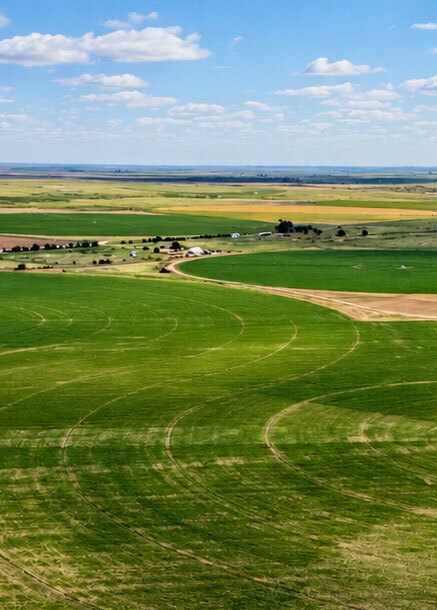
Properties such as Sherman County State Line Farm near Stratford, Texas, illustrate how organic production can fit into an established agricultural operation. With certified-organic irrigated acreage alongside conventional agricultural uses, the property offers a practical example of the considerations facing today's farmland buyers. Understanding these differences is important for farmers evaluating production systems and for agricultural landowners and buyers considering the long-term productivity of Texas farmland.
What Is Organic Farming?
Certified-organic farming is an agricultural production system regulated by the United States Department of Agriculture (USDA) through its National Organic Program. Organic farming relies on approved practices to manage soil fertility, weeds, insects, and crop health while meeting federal standards.
Practices commonly include crop rotations, approved soil amendments, mechanical weed management, and biological pest controls. Organic farming does not mean farming without fertilizers or pesticides: certain materials are permitted while others are prohibited.
How Does Farmland Become Certified Organic?
Farmland generally must complete a 36-month transition period following the last application of a prohibited substance before crops harvested from that land can be sold as certified organic. During this period, producers may face organic-compliant management expenses without receiving certified-organic premiums.
Once certified, operations must maintain records, comply with applicable standards, and undergo required inspections. Documented certification history is important when evaluating existing organic farmland.
What Is Conventional Farming?
Conventional farming generally refers to systems that may use approved synthetic fertilizers, herbicides, pesticides, and genetically engineered crop varieties. These tools provide a broad range of options for managing soil fertility, weeds, insects, and production risks.
In the Texas Panhandle, conventional agriculture supports corn, wheat, sorghum, cotton, and livestock feed crops. Many conventional producers also use conservation tillage, precision irrigation, soil testing, and crop rotations. The principal distinctions involve permitted inputs, certification, and access to particular markets.
How Do Organic and Conventional Farming Costs Compare?
Both systems incur seed, fertility, irrigation, equipment, labor, harvesting, transportation, and land expenses. The distribution of costs can differ substantially.
Organic Farming Production Costs
Organic producers may use approved manure, compost, crop rotations, mechanical cultivation, and biological management rather than many conventional synthetic inputs. Additional expenses can include:
- Organic-compliant seed and planting materials
- Transportation and application of approved soil amendments
- Mechanical cultivation and weed management
- Certification, inspections, and recordkeeping
- Equipment cleaning, product segregation, and specialized marketing
A 2026 Texas A&M AgriLife publication discussed poultry manure at approximately $43 per ton before transportation and application. At a hypothetical five tons per acre, materials alone would cost $215 per acre. Actual rates depend on soil tests, nutrient needs, manure composition, and certification rules.
Conventional Farming Production Costs
The 2026 Texas A&M AgriLife Extension Panhandle budgets provide selected conventional corn silage benchmarks:
| Expense | Estimated Cost Per Acre |
|---|---|
| Seed | $132.00 |
| Nitrogen and phosphorus fertilizer materials | $226.20 |
| Herbicides | $95.20 |
| Miticide | $44.00 |
| Irrigation energy | $100.00 |
| Harvesting and hauling | $337.50 |
These are selected expenses, not total production costs. Conventional sorghum silage budgets estimate approximately $16 per acre for seed, $118.35 for fertilizer materials, $58.30 for herbicides, and $70 for irrigation energy.
The meaningful comparison is the total cost of producing and marketing each bushel or ton—not simply the fertilizer or chemical bill.
Does Organic Farming Produce Lower Crop Yields?
Organic yields can be lower, although differences vary with crop, soil, irrigation, weather, and management. A June 2026 Purdue University Center for Commercial Agriculture analysis of 2021–2025 FINBIN data reported:
| Crop | Average Organic Yield Difference |
|---|---|
| Corn grain | Approximately 24% lower |
| Winter wheat grain | Approximately 6% lower |
These findings are not controlled Texas Panhandle field trials and should not be applied directly to silage crops.
Corn Silage, Sorghum Silage, and Wheatlage
The 2026 AgriLife Panhandle conventional budgets assume about 27 tons per acre for corn silage and 20 tons for sorghum silage. A related triticale silage budget assumes 10 tons per acre; triticale is not wheatlage.
Comparable regional organic silage yields were not established in the reviewed research. Producers should use field records and locally supported estimates. For forage, dry matter and nutritional value also matter: more wet tons do not always mean more feed value.
Can Higher Organic Crop Prices Offset Lower Yields?
Certified-organic crops may receive premiums when specialized demand exceeds supply. Yet higher prices alone do not guarantee higher net returns.
Organic vs. Conventional Corn Grain Prices
A USDA national organic grain report covering September 28–October 9, 2026, reported organic corn forward contracts of approximately $10.50–$11.60 per bushel, averaging $11.33. Conventional Texas Panhandle elevator bids on October 27 ranged from approximately $4.79–$5.29 per bushel.
These are not directly comparable local cash prices: geography, timing, delivery terms, contracts, transportation, storage, and buyer availability differ. They illustrate potential premiums, not guaranteed local returns.
A Hypothetical Profitability Comparison
| Financial Measure | Organic | Conventional |
|---|---|---|
| Yield per acre | 152 bushels | 200 bushels |
| Selling price per bushel | $11.00 | $5.00 |
| Gross revenue per acre | $1,672 | $1,000 |
Under these hypothetical assumptions, organic production produces $672 more gross revenue per acre despite a lower yield. This is not additional profit: fertility, cultivation, certification, transportation, labor, rotation, and transition costs must still be considered.
Is Organic Silage More Profitable Than Conventional Silage?
Silage contains substantial moisture and can be expensive to haul, making local livestock customers particularly important. The 2026 conventional AgriLife Panhandle budgets assume:
| Crop | Yield Per Acre | Price Per Ton | Gross Revenue Per Acre |
|---|---|---|---|
| Corn silage | 27 tons | $55 | $1,485 |
| Sorghum silage | 20 tons | $50 | $1,000 |
Verified local organic prices for corn silage, sorghum silage, and wheatlage were not established in the reviewed sources. Organic grain premiums should not be assumed to carry over to forage.
How Much of an Organic Premium Is Needed?
If an organic silage operation yields 20% fewer tons per acre while per-acre costs remain unchanged, it needs a 25% higher selling price to maintain the same gross revenue and operating margin. Corn silage would require approximately $68.75 per ton rather than $55; sorghum silage, $62.50 rather than $50.
With $100 more in per-acre organic production costs, the hypothetical margin-equivalence prices rise to approximately $73.38 for corn silage and $68.75 for sorghum silage. These are illustrative calculations, not observed organic bids or expected yields.
Why Organic Dairy Demand Matters in the Texas Panhandle
The Texas Panhandle has an established dairy industry. Texas A&M AgriLife has documented organic dairy activity in the Panhandle and South Plains, including the Muleshoe area and agricultural areas toward Stratford. Certified-organic dairies generally require organically produced agricultural feed, creating potential demand for organic corn grain and forage.
Organic Corn Grain and Corn Silage
Organic grain can be sold through specialized buyers, feed mills, or potentially directly to livestock operations. Organic corn silage provides forage and grain components, but its moisture makes proximity to customers important. Existing organic dairies do not guarantee new outside-purchase demand; some produce their own feed or have supplier contracts.
Organic Wheatlage and Sorghum Silage
These crops can provide alternative forage, but value depends on dry-matter content, digestibility, energy, maturity, and buyer feeding programs. Producers should confirm nutritional specifications, prices, and delivery arrangements before committing acreage.
Organic Dairy Feed Requirements
USDA organic livestock standards generally require certified-organic agricultural feed. Organic dairy ruminants must obtain an average of at least 30% of dry-matter intake from grazed pasture during a grazing season of at least 120 days. Stored organic forage and grain can complement pasture, although individual dairy purchasing needs vary.
Organic vs. Conventional Farming: What About Water and the Environment?
Some producers favor organic practices for soil health, biodiversity, or reduced reliance on certain synthetic inputs. Others favor conventional systems for flexibility and established risk-management tools. Neither system is automatically more environmentally sustainable: outcomes depend on actual management.
Organic systems often emphasize rotations and biological soil management; conventional operations may use precision irrigation, conservation tillage, soil testing, and cover crops.
Water Availability Is Especially Important in the Texas Panhandle
Irrigation capacity and pumping costs affect crop choices, yields, operating expenses, and long-term sustainability. Water needs depend on crop, weather, soil, irrigation efficiency, and management—not certification alone. Buyers should assess irrigation infrastructure, groundwater availability, regulations, and long-term pumping capacity.
A Texas Panhandle Example: Certified-Organic Farmland at Sherman County State Line Farm
Sherman County State Line Farm near Stratford, Texas, illustrates how certified-organic and noncertified agricultural acreage can coexist within one property. The farm includes irrigated cropland, dryland corners, and pasture.
All irrigated acres are certified organic, while the dryland corners and pasture are not certified organic.
Certification does not necessarily apply to every acre within a property boundary. Buyers should evaluate field-specific certification, production history, soils, irrigation capacity, and local markets. Certified-organic irrigated acreage may offer access to specialized markets when buyer demand and management support it, but certification does not guarantee profitability or higher real estate value.
Explore the property: Sherman County State Line Farm – Texas Farmland for Sale.
How Does Organic Certification Affect Texas Panhandle Farmland Value?
Productive farmland value reflects soil quality, water, irrigation improvements, production history, location, and market demand. Existing organic certification may appeal to certain buyers or tenants by avoiding a new transition period. Yet a well-watered conventional farm with strong production and multiple markets may be equally or more attractive to other buyers.
The appropriate investment decision depends on acquisition cost, expected operating returns, resources, and long-term use.
A Regional Agricultural Land Perspective
Zurick Labrier, ALC, Partner with Mason & Morse Ranch Company, brings agricultural experience and regional market knowledge to farm and ranch transactions in the Texas and Oklahoma Panhandles. Raised in the agricultural community of Dalhart, Texas, Zurick understands the importance of evaluating land through soil productivity, irrigation, infrastructure, local markets, and realistic earning potential. Organic certification adds a consideration, not a substitute for these fundamentals.
What Should Farmers Consider Before Transitioning to Organic Production?
| Consideration | Important Question |
|---|---|
| Certification | Can the farm complete transition and maintain certification? |
| Production costs | What additional expenses will management require? |
| Crop yields | What levels are realistic for this operation? |
| Irrigation | Can available water support the intended crops? |
| Market access | Are dependable organic buyers available? |
| Price premiums | Will actual offers offset added costs and yield differences? |
| Transportation | How will freight affect profitability? |
| Management | Are labor, equipment, and expertise sufficient? |
| Long-term returns | How do net returns compare over several seasons? |
For some operations organic farming may provide a meaningful opportunity; for others conventional production may offer stronger or more predictable returns.
Which Farming System Is More Profitable in the Texas Panhandle?
Organic farming can offer premium-priced crops and specialized markets, especially where certified-organic livestock operations create dependable demand. Conventional farming offers established methods, broad marketing channels, and flexibility in agricultural inputs. Neither guarantees superior financial performance.
For corn grain, market observations illustrate possible organic premiums. For corn silage, wheatlage, and sorghum silage, buyer relationships, verified prices, forage quality, and transportation are particularly important. Water, soil productivity, and long-term stewardship matter in either system.
Ultimately, the more profitable farming system is the one that delivers the strongest sustainable net return after production expenses, yields, water resources, market access, and risk. The best agricultural decisions begin with understanding the land itself.
About Zurick Labrier, ALC
Zurick Labrier is a Partner with Mason & Morse Ranch Company and an experienced agricultural land broker serving the Texas and Oklahoma Panhandles and surrounding High Plains. His agricultural background and regional market experience inform his perspective on productive farmland, agricultural operations, and rural land values.
Mason & Morse Ranch Company knows what drives value on the ground.
Related Reading
- Texas and Oklahoma Panhandle Land Broker: Why Zurick Labrier Is the Go-To Agent
- Zurick Labrier: 2025 RLI Texas and Oklahoma Broker of the Year
- Texas A&M AgriLife Extension 2026 Panhandle Crop Budgets
Research Sources
- Texas A&M AgriLife Extension — 2026 District 1 Panhandle crop budgets for corn silage, sorghum silage, and triticale silage.
- USDA Agricultural Marketing Service — Texas Daily Grain Bids, October 27, 2026.
- USDA Agricultural Marketing Service — National Organic Grain and Feedstuff Report, September 28–October 9, 2026.
- Purdue University Center for Commercial Agriculture — Michael Langemeier, Conventional and Organic Enterprise Net Returns, June 12, 2026.
- USDA National Organic Program — Crop production, transition, certification, and livestock-feed requirements.
- Texas A&M AgriLife Organic — Crop resources, regional organic dairy research, and manure and compost guidance.